
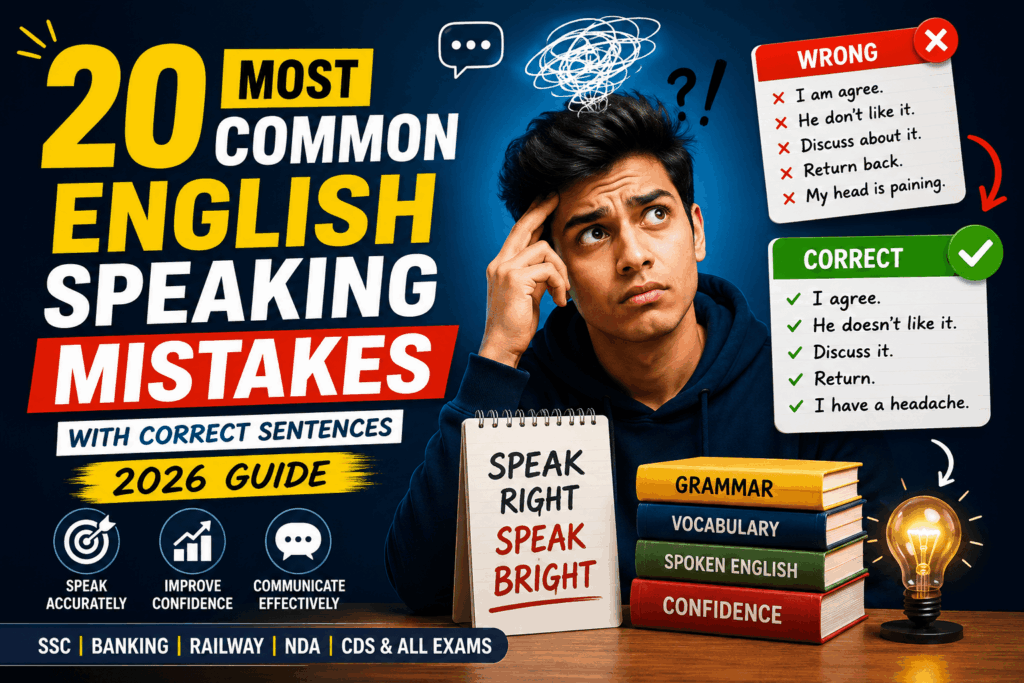
Speaking English confidently requires more than vocabulary—it also means avoiding common English speaking mistakes.
In this guide, you’ll learn the most frequent spoken English mistakes, correct sentence patterns, grammar tips, and practical examples to improve your communication skills.
Do you hesitate while speaking English? Do you often translate Hindi into English and end up making mistakes?
In this article, you’ll learn the **20 most common English speaking mistakes**, along with:
* ❌ Wrong Sentence
* ✅ Correct Sentence
* 📖 Reason
* 💡 Easy Explanation
* 🎯 Extra Example
Let’s improve your spoken English one mistake at a time.
1. Using “He Don’t” Instead of “He Doesn’t”
❌ Wrong
He don’t like coffee.
✅ Correct
He doesn’t like coffee.
Reason
With **He, She, It**, we use **doesn’t**, not **don’t**.
Explanation
“He” is a third-person singular subject. Therefore, the helping verb should be **does**, not **do**.
Extra Examples
❌ She don’t understand.
✅ She doesn’t understand.
❌ It don’t work.
✅ It doesn’t work.
2. Saying “I am Agree”
❌ Wrong
I am agree with you.
✅ Correct
I agree with you.
Reason
“Agree” is a verb, not an adjective.
Explanation
Never use **am/is/are** before “agree.”
Extra Examples
❌ We are agree.
✅ We agree.
3. Saying “Discuss About”
❌ Wrong
Let’s discuss about the problem.
✅ Correct
Let’s discuss the problem.
Reason
The verb **discuss** itself means “talk about.”
So “about” becomes unnecessary.
Extra Example
❌ We discussed about politics.
✅ We discussed politics.
4. Using “Return Back”
❌ Wrong
Please return back tomorrow.
✅ Correct
Please return tomorrow.
Reason
Return already means “come back.”
The word **back** is unnecessary.
5. Saying “My Head is Paining”
❌ Wrong
My head is paining.
✅ Correct
I have a headache.
OR
My head hurts.
Reason
Native speakers don’t use “My head is paining.”
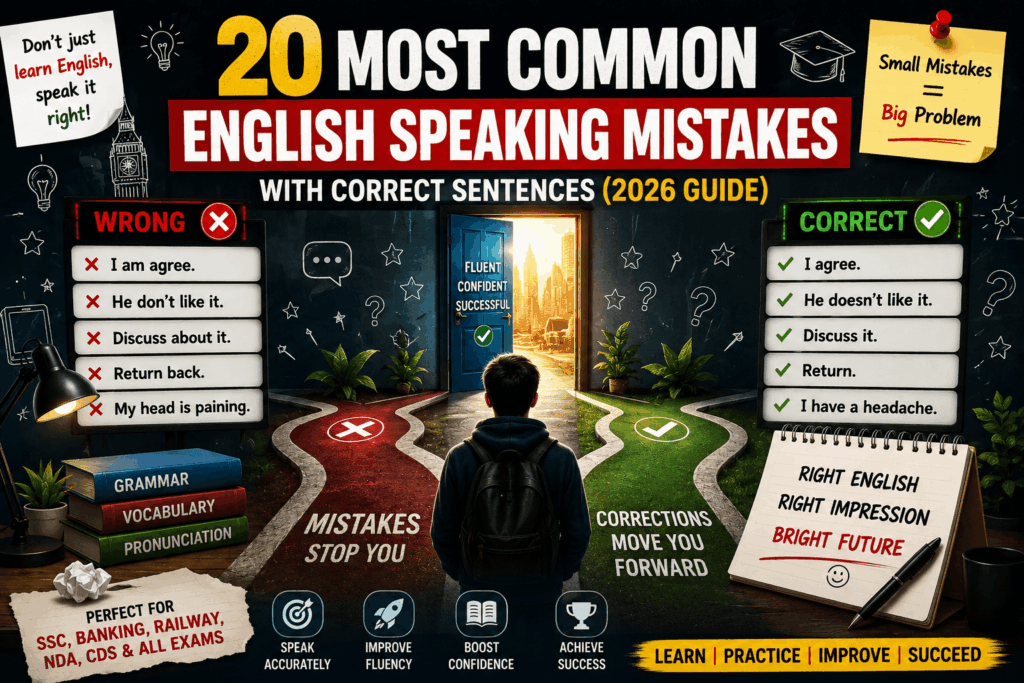
Common English Speaking Mistakes
6. Saying “I Didn’t Went”
❌ Wrong
I didn’t went there.
✅ Correct
I didn’t go there.
Reason
After **did**, always use the first form (V1).
More Examples
❌ Didn’t ate
✅ Didn’t eat
❌ Didn’t saw
✅ Didn’t see
7. Saying “More Better”
❌ Wrong
This book is more better.
✅ Correct
This book is better.
Reason
Better is already a comparative adjective.
Never use **more** before **better**.
8. Saying “One of My Friend”
❌ Wrong
One of my friend is here.
✅ Correct
One of my friends is here.
Reason
After “One of,” always use a plural noun.
9. Saying “He is Senior Than Me”
❌ Wrong
He is senior than me.
✅ Correct
He is senior to me.
Reason
Senior, junior, superior, and inferior take **to**, not **than**.
10. Saying “I Am Having”
❌ Wrong
I am having two brothers.
✅ Correct
I have two brothers.
Reason
Possession is usually expressed with **have**, not **am having**.
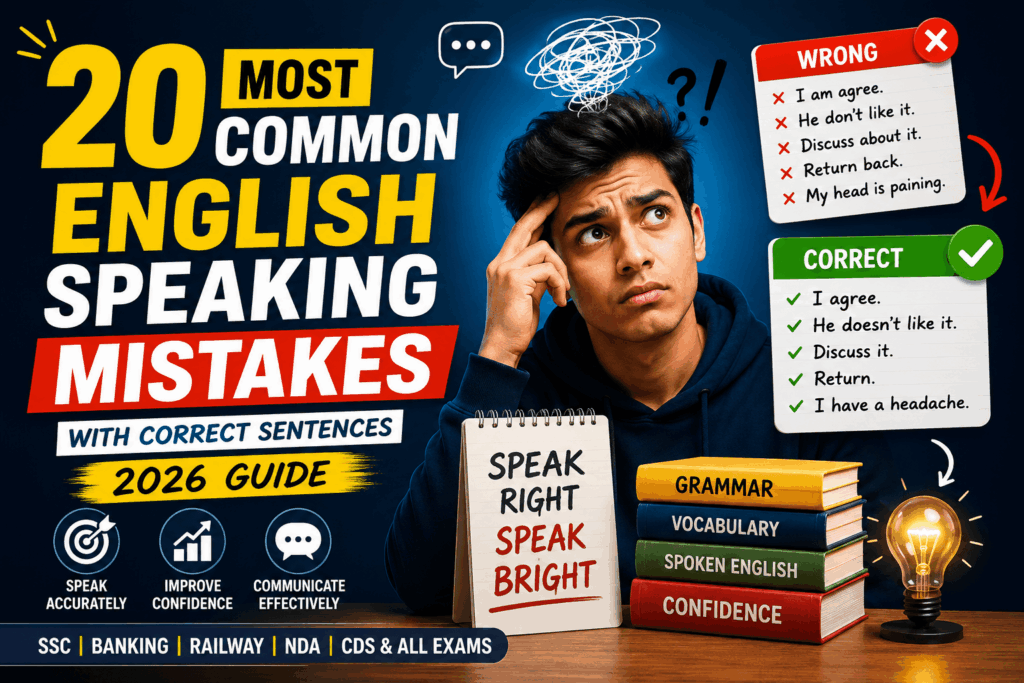
Common English Speaking Mistakes
11. Saying “Open the Light”
❌ Wrong
Please open the light.
✅ Correct
Please turn on the light.
Reason
We turn lights on or off; we do not open or close them.
12. Saying “Close the Fan”
❌ Wrong
Close the fan.
✅ Correct
Turn off the fan.
13. Saying “Myself Ashish”
❌ Wrong
Myself Ashish.
✅ Correct
I am Ashish.
OR
My name is Ashish.
Reason
“Myself” is used for emphasis or reflexive situations, not introductions.
14. Saying “Today Morning”
❌ Wrong
I met him today morning.
✅ Correct
I met him this morning.
Reason
English uses **this morning**, **this afternoon**, and **this evening**.
15. Saying “I Am Belong”
❌ Wrong
I am belong to Prayagraj.
✅ Correct
I belong to Prayagraj.
Reason
Belong is a verb.
Do not use “am” before it.
Common English Speaking Mistakes
16. Saying “Order for Tea”
❌ Wrong
I ordered for tea.
✅ Correct
I ordered tea.
Reason
Order does not require “for.”
17. Saying “He Gave Me An Advice”
❌ Wrong
He gave me an advice.
✅ Correct
He gave me some advice.
OR
He gave me a piece of advice.
Reason
Advice is an uncountable noun.
18. Saying “I Know Him Very Good”
❌ Wrong
I know him very good.
✅ Correct
I know him very well.
Reason
Use the adverb **well** to describe a verb.
19. Saying “What is Your Good Name?”
❌ Wrong
What is your good name?
✅ Correct
What is your name?
Reason
“Good name” is a direct translation from Indian languages and is not natural English.
20. Saying “I Have Less Friends”
❌ Wrong
I have less friends.
✅ Correct
I have fewer friends.
Reason
Use **fewer** with countable nouns and **less** with uncountable nouns.
Examples:
✅ Fewer students
✅ Fewer books
✅ Less water
✅ Less money
Common English Speaking Mistakes
Final Tips to Avoid Speaking Mistakes
* Think in English instead of translating from Hindi.
* Learn sentence patterns, not isolated words.
* Speak English for 15–20 minutes every day.
* Listen to native speakers through podcasts, interviews, and English news.
* Record your own voice and identify recurring mistakes.
* Revise these 20 mistakes regularly until the correct forms become natural.
ADVICE FROM AUTHOR
Mastering these common English speaking mistakes will help you speak more accurately and confidently in everyday conversations, interviews, and competitive exams. Practice the correct sentence patterns regularly, avoid repeated grammar errors, and make spoken English a daily habit. Consistent practice is the key to improving your English communication skills.