
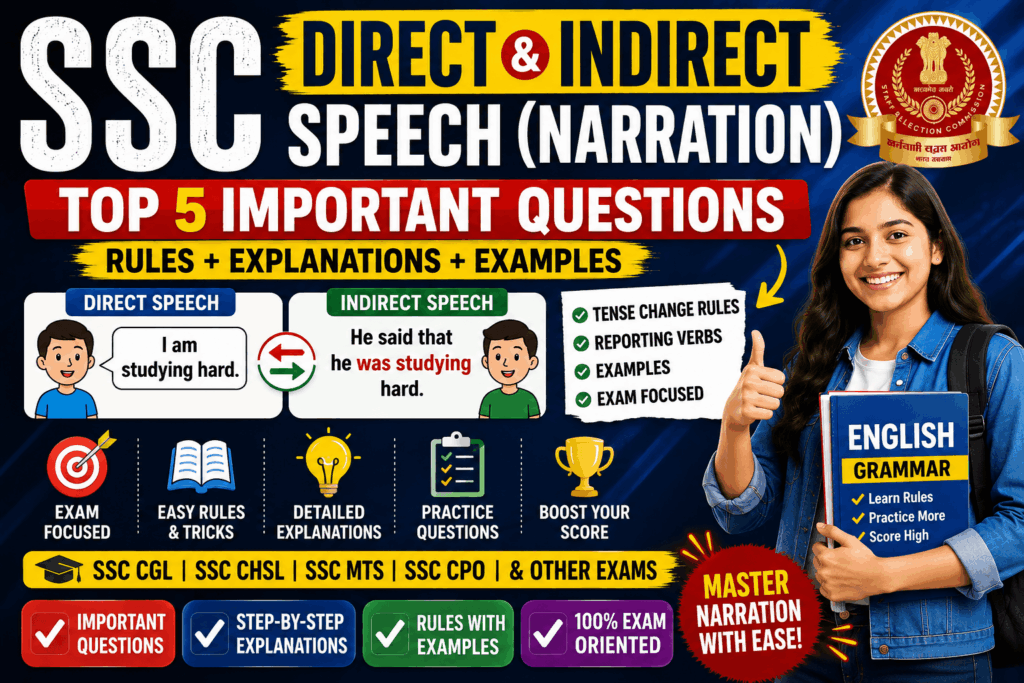
Direct and Indirect Speech is an important topic in SSC English Grammar and is frequently asked in SSC CGL, CHSL, MTS, CPO, and other competitive exams.
This article covers important Narration Questions with answers, explanations, and grammar rules to help candidates improve accuracy and score better in the English section.
SSC Direct and Indirect Speech Notes (Q1–Q5)
Question 1:
Rahul said, “I am busy.”
A. Rahul said that he is busy.
B. Rahul said that he was busy.
C. Rahul says that he was busy.
D. Rahul said that I was busy.
Right Answer:
✅ B. Rahul said that he was busy.
Correct Indirect Speech:
Rahul said that he was busy.
Explanation:
Direct Speech:
Rahul said, “I am busy.”
Reporting Verb = Said (Past Tense)
Since the reporting verb is in the past tense, the present tense changes into the corresponding past tense in indirect speech.
am → was
SSC Rule:
Present Simple/Present Continuous → Past Simple/Past Continuous
Similar Examples:
He said, “I am tired.”
→ He said that he was tired.
She said, “I am working.”
→ She said that she was working.
Question 2:
The teacher said, “The Earth revolves around the Sun.”
A. The teacher said that the Earth revolved around the Sun.
B. The teacher said that the Earth revolves around the Sun.
C. The teacher said that the Earth had revolved around the Sun.
D. The teacher said that the Earth was revolving around the Sun.
Right Answer:
✅ B. The teacher said that the Earth revolves around the Sun.
Correct Indirect Speech:
The teacher said that the Earth revolves around the Sun.
Explanation:
This sentence expresses a universal truth.
Universal truths do not change their tense in indirect speech.
SSC Rule:
Universal Truth → No Change of Tense
Similar Examples:
The teacher said, “Honesty is the best policy.”
→ The teacher said that honesty is the best policy.
He said, “The Sun rises in the east.”
→ He said that the Sun rises in the east.
Question 3:
She said, “I have finished my work.”
A. She said that she has finished her work.
B. She said that she had finished her work.
C. She said that she finished her work.
D. She said that she had been finishing her work.
Right Answer:
✅ B. She said that she had finished her work.
Correct Indirect Speech:
She said that she had finished her work.
Explanation:
Present Perfect changes into Past Perfect in indirect speech.
have finished → had finished
SSC Rule:
Present Perfect → Past Perfect
Similar Examples:
He said, “I have completed the task.”
→ He said that he had completed the task.
They said, “We have won the match.”
→ They said that they had won the match.
Question 4:
He said to me, “Can you help me?”
A. He asked me if I could help him.
B. He said to me that I could help him.
C. He asked me can I help him.
D. He told me if I can help him.
Right Answer:
✅ A. He asked me if I could help him.
Correct Indirect Speech:
He asked me if I could help him.
Explanation:
Interrogative sentences are introduced by “if” or “whether” in indirect speech.
said to → asked
can → could
SSC Rule:
Question Sentence → asked + if/whether
Similar Examples:
She said to me, “Can you swim?”
→ She asked me if I could swim.
He said to her, “Will you come?”
→ He asked her whether she would come.
Question 5:
The officer said, “Close the gate.”
A. The officer ordered to close the gate.
B. The officer ordered that the gate should be closed.
C. The officer ordered the gate closed.
D. The officer said to close the gate.
Right Answer:
✅ B. The officer ordered that the gate should be closed.
Correct Indirect Speech:
The officer ordered that the gate should be closed.
Explanation:
Imperative sentences expressing command are changed using reporting verbs such as ordered, commanded, or instructed.
SSC Rule:
Command/Order → ordered + that + should
Similar Examples:
The captain said, “Move forward.”
→ The captain ordered that they should move forward.
The teacher said, “Maintain silence.”
→ The teacher ordered that silence should be maintained.
ADVICE FROM AUTHOR
Regular practice of Direct and Indirect Speech Questions helps candidates master narration rules and avoid common mistakes in exams.
By learning these important examples and explanations, SSC aspirants can improve their grammar skills, increase confidence, and perform better in SSC, Banking, Railway, and other competitive examinations.